
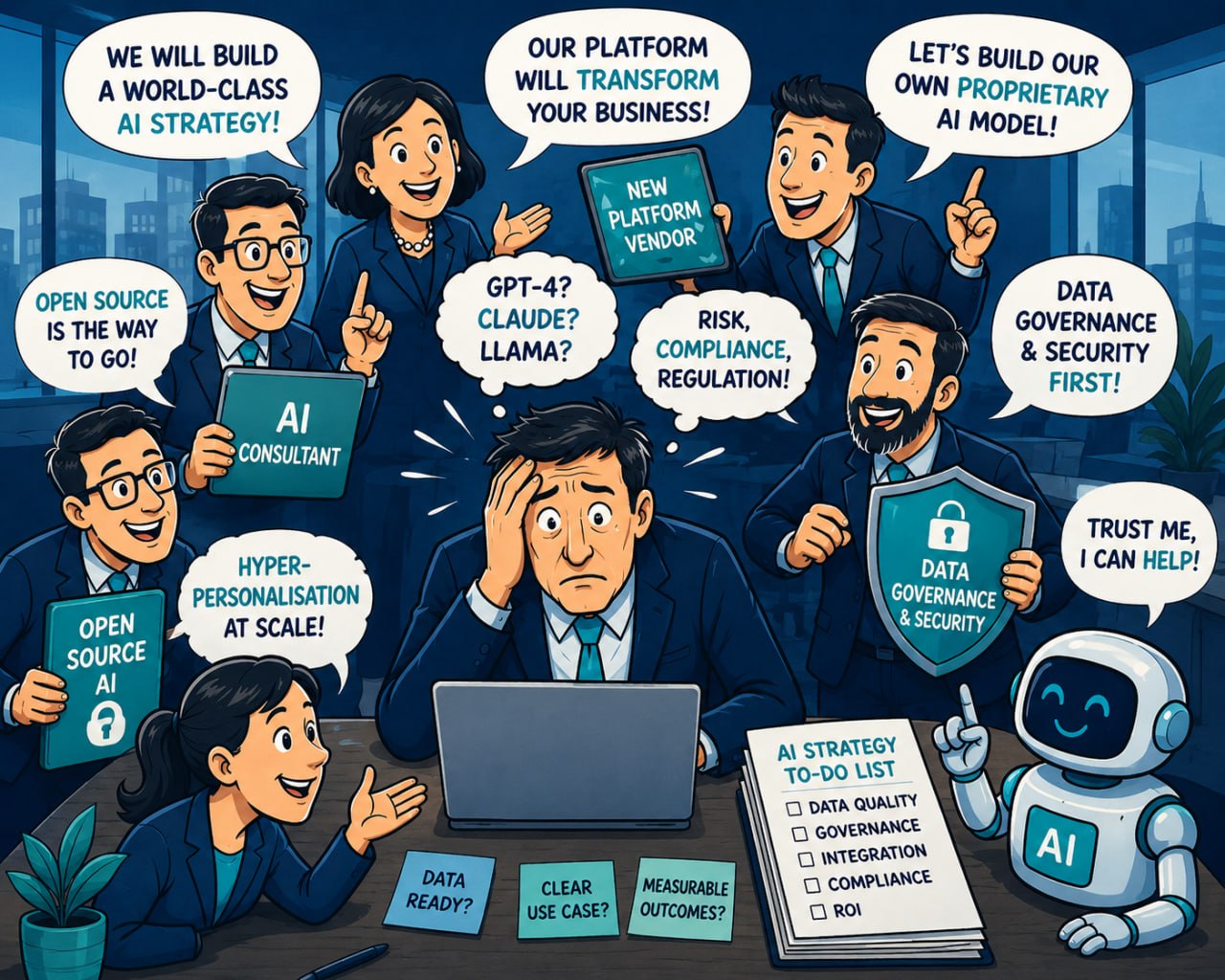
AI has been so heavily hyped that the underlying premise often seems to be that if you are not investing in AI, you risk falling behind competitors, suffering margin compression and losing talent.
Or is it simply FOMO (Fear of Missing Out)?
There are reportedly hundreds of FinTechs, wealth managers and banks actively developing new AI models, applications and agents.
According to industry research, most wealth management AI initiatives are currently focused on augmenting human advisers through:
- Adviser productivity and workflow automation
- Hyper-personalisation
- Data and infrastructure readiness
- Risk mitigation and compliance
- Client acquisition and retention
Up to 95% of wealth management firms plan to increase their AI spending, viewing it as a primary technology priority.
However, despite the massive volume of experimentation, up to 95% of AI pilot projects initially fail to demonstrate measurable financial returns, often due to fragmented technology stacks or poor data quality. As a result, many firms are shifting their 2026 AI investments towards initiatives that can demonstrate a clear and measurable return on investment (ROI).
So What Should Firms Do?
- Bring in AI consultants?
- Continue to rely on internal technology teams?
- Combine internal and external expertise?
- Employ additional staff?
- Rely on existing platform providers?
- Replace existing platforms entirely?
- Or simply wait and see?
The reality is that there is no single answer.
The most successful AI initiatives tend to start with a clearly defined business problem rather than a technology objective. Whether the goal is improving adviser productivity, enhancing client service, reducing operational risk or streamlining compliance, firms that focus on specific outcomes are often better positioned to achieve measurable results.
Key Considerations
There are several important questions that firms should be asking:
- Does the team really have the necessary domain knowledge?
- Which LLM is the right fit?
- Do you use Open Source AI?
- How do you ringfence sensitive data?
- Do you risk losing valuable intellectual property?
- Is your data actually AI-ready?
One of the most common lessons emerging across the wealth management industry is that AI readiness depends on data readiness. Even the most sophisticated models can only perform as well as the quality, consistency and accessibility of the information they rely upon.
Experience Matters
At m2Wealth, we bring more than 40 years of technology and domain expertise in investment data to the wealth management industry.
Our experience has shown that successful AI initiatives are rarely driven by technology alone. They require a combination of deep industry knowledge, high-quality data, sound governance and a clear understanding of business objectives.
We have developed specialised vertical AI models and agents alongside the use of general-purpose LLMs, helping address investment data challenges while supporting a broad range of wealth management functions.
Looking Ahead
The opportunity presented by AI is substantial, but so are the implementation challenges. Firms that combine strong data foundations, practical deployment strategies and measurable business goals are likely to be best positioned to realise sustainable value from their AI investments.
As the industry continues to evolve, the focus is shifting away from AI for AI’s sake and towards solutions that deliver tangible outcomes for advisers, firms and clients alike.